THE BIG IDEA: In a striking role reversal, the Democratic nominee for president in 2016 is likely to be more of an internationalist, more ...
 THE BIG IDEA:
In a striking role reversal, the Democratic nominee for president in 2016 is likely to be more of an internationalist, more supportive of free trade and, at least on paper, more hawkish than her Republican opponent.
George H.W. Bush was still popular because of his leadership during the Gulf War when Bill Clinton decided to challenge him in 1992. The then-Arkansas governor won by focusing on the economy, making the case that the country should turn inward and invest a post-Cold War peace dividend in domestic programs.
In 2016, Republican front-runner Donald Trump is trying to make a similar case. After 13 years of seeming quagmire in the Middle East, the billionaire businessman is promising to scale back the U.S. footprint overseas. And it is former Secretary of State Hillary Clinton who must persuade the American people on the importance of U.S. leadership in the world, to both keep us secure and ensure our prosperity.
Trump came to The Post’s newsroom yesterday for an hour-long sit-down with the editorial board. He outlined a foreign policy that sounded significantly more isolationist than interventionist. “I don’t think we should be doing nation-building anymore,” he said. “I think it’s proven not to work. . . . I just think we have to rebuild our country.”
- “He twice made a point of saying he was not prepared to trigger a third world war, first in reference to Russia and Ukraine, a second time in a discussion about China’s moves in the South China Sea,” Dan Balz notes in his column. “He said he would ‘find it very, very hard’ to approve sending tens of thousands of U.S. troops to fight the Islamic State, even if the generals at the Pentagon recommended it.”
- On NATO: “We certainly can’t afford to do this anymore. … NATO is costing us a fortune, and yes, we’re protecting Europe with NATO, but we’re spending a lot of money. … Ukraine is a country that affects us far less than it affects other countries in NATO, and yet we’re doing all of the lifting … Why is it that Germany’s not dealing with NATO on Ukraine?”
- On whether the United States benefits from its involvement in Asia, Trump replied: “Personally, I don’t think so. … I think we were a very powerful, very wealthy country. And we’re a poor country now. We’re a debtor nation. … South Korea is very rich, great industrial country, and yet we’re not reimbursed fairly for what we do. We’re constantly sending our ships, sending our planes, doing our war games — we’re reimbursed a fraction of what this is all costing.” (Philip Rucker and Robert Costa’s story; Read the full transcript of the session, which was entirely on the record, here.)
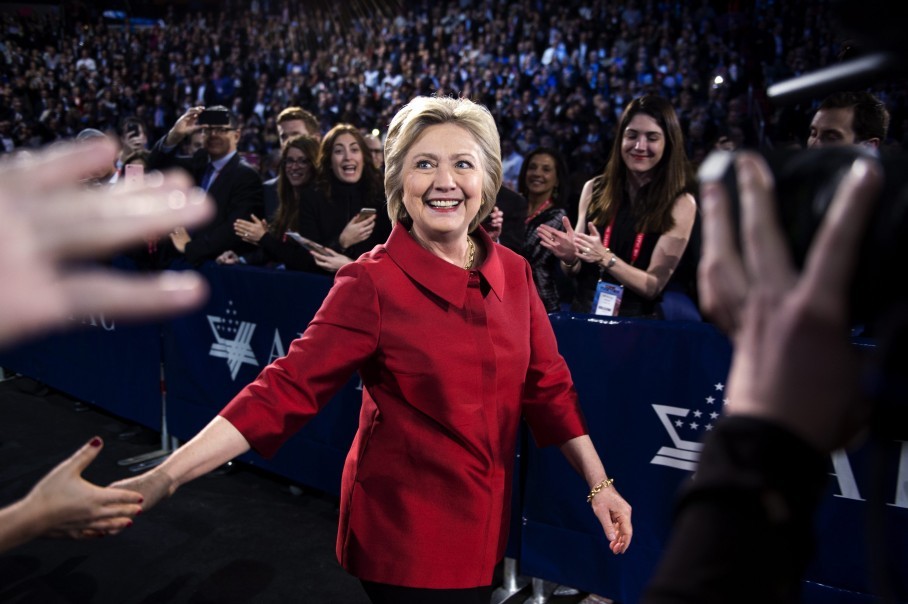
Hillary Clinton shakes hands with supporters before her speech at the AIPAC (American Israel Political Action Committee) conference (Shawn Thew/EPA)
-- In a stark contrast, Clinton didn’t name Trump but she extensively criticized his foreign policy vision during her speech to AIPAC at the Verizon Center. She said he “would insult our allies, not engage them, and embolden our adversaries, not defeat them.”
“For the security of Israel and the world, we need America to remain a respected global leader, committed to defending and advancing the international order,” she said.
-- The dueling speeches offered a taste of what the debate on global issues could look like this fall. Clinton would defend her support for the U.S. policy in Libya in the face of Trump attacks, for instance. Trump might pledge not to put more boots on the ground in Iraq, while Clinton – who understands that words have consequences – would keep her options open.
This would be a surreal debate for Bernie Sanders’s supporters to watch. It’s hard to imagine many anti-war protestors ultimately casting ballots for The Donald. But perhaps he could dampen enthusiasm for Clinton by emphasizing her vote for the war in Iraq in 2002, which he claims he always opposed.
It would be equally surreal for neo-conservatives like Dick Cheney or Bill Kristol to see the Republican standard bearer reiterate his view that the U.S. went into Iraq in 2003 on false pretenses. The positions Trump outlined yesterday at The Post may, in that vein, increase the likelihood of a credible third-party candidate emerging. Rick Perry, one of the names mentioned, could emphasize his experience in the Armed Forces as he seeks to pick off a state like Texas, again hypothetically. (Let’s see how Ted Cruz does in today’s Arizona primary…)
-- So why is Trump doing this? Here are three theories:
1. He doesn’t want to be seen as too trigger happy. While Clinton wants to be seen as tough and presidential, Trump (at this moment in the race) doesn’t want to be seen as someone who cannot be trusted with nuclear launch codes. Promising restraint might make him more palatable to some voters.
2. He recognizes a disconnect between Republican elites and the grassroots. Conservative thought leaders in D.C. are much more willing to use force than a lot of rank-and-file Republicans. Even in a state like South Carolina, with a proud military tradition, Trump was not hurt by his outspoken opposition to the war in Iraq and criticism of George W. Bush.
3. It’s essential to Trump’s brand that he not look too politically correct. “I didn’t come here tonight to pander to you about Israel,” he said at the start of his AIPAC speech in D.C. last night. “That’s what politicians do — all talk, no action.” As he tries to offer an olive branch to the party establishment, he’s also making clear that he won’t be bound by GOP orthodoxy. This might help him assure supporters that he’s not going to “go Washington.”
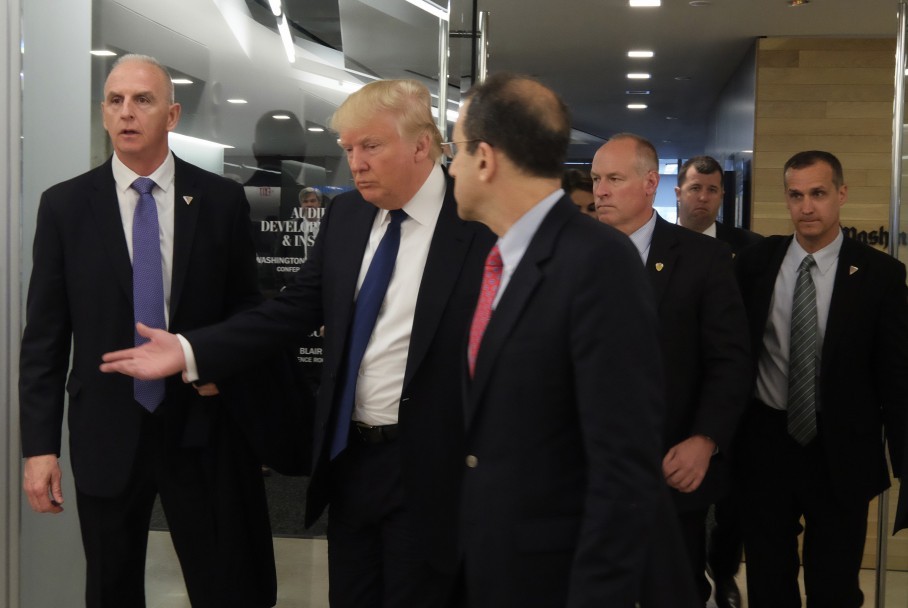
Trump departs his meeting with The Post's Editorial Board. (Photo by Bonnie Jo Mount/The Washington Post)
-- But, but, but: Trump is like a box of chocolates. You never know what you’re going to get. He may talk like a dove now, but it’s still just so so so so so easy to envision him being quick to anger and using military force with little provocation. Especially compared to the more self-disciplined and restrained Clinton.
Trump is all over the map on lots of issues: He’ll reverse himself mid-sentence on something like H1B visas. Yesterday during a press conference he said Israel should reimburse the U.S. for some of the foreign aid it has received. Then, just a few minutes later, he flip-flopped, the Dallas Morning News’ Todd Gillman notes.
Trump spins his constantly evolving policy positions as a virtue. He says it will keep America’s enemies always guessing. Asked at The Post yesterday how he’d check Chinese expansionism in the South China Sea, he replied: “We have to be unpredictable. We’re totally predictable. And predictable is bad.”
The Post’s Editorial Board, which is independent from the news division, writes this morning that Trump’s answers during the session “left little doubt how radical a risk the nation would be taking in entrusting the White House to him.” From the editorial: “While it is true that ambiguity sometimes can be useful in diplomacy, a lack of clarity also can be dangerous, enticing rivals to be aggressive and allies to seek new friends.”
Clinton, for her part, framed Trump as erratic and unpredictable during her AIPAC speech: “We need steady hands,” she said. “Not a president who says he’s neutral on Monday, pro-Israel on Tuesday and who knows what on Wednesday because everything is negotiable. Well, my friends, Israel’s security is nonnegotiable!” (Abby Phillip)
-- He’d never admit it, but Trump really wants to be taken seriously by D.C. elites. That’s a big part of why he ran in the first place. Months ago, he got ridiculed when he said he learns about national security issues by watching “the shows” on television. He’s taken heat for declining to name the people who are advising him. So, at the start of The Post’s editorial board meeting, Trump pulled out a piece of paper and read five names of people who he identified as foreign policy advisers. Missy Ryan runs through their biographies:
- Joseph Schmitz served as inspector general at the Department of Defense during the Bush administration. A 2005 L.A. Times investigation revealed issues during his time there, saying he blocked certain investigations and may have violated ethics guidelines for accepting gifts. He later became a senior official at the Prince Group, the parent company of defense contractor Blackwater.
- George Papadopoulos, a 2009 graduate of DePaul University, previously advised Ben Carson. On his LinkedIn page, Papadopolous lists among his awards and honors that he was U.S. Representative at the 2012 Geneva International Model United Nations!
- Walid Phares is provost at BAU International University.
- J. Keith Kellogg Jr. is a former commander of the 82nd Airborne Division and was chief operating officer for the Coalition Provisional Authority in Baghdad.
- Carter Page, a longtime energy executive and founder of Global Energy Capital, formerly served as a fellow at the Council on Foreign Relations.
-- In the same vein of trying to be taken seriously, Trump even spoke from two teleprompters last night! “This is the candidate who once declared that teleprompters should outlawed on the campaign trail and who has colorfully criticized his rivals for using the machines,” Jenna Johnson notes. “Trump's prepared remarks, which were posted on his campaign website on Monday evening, are mostly written as he speaks, with a heavy dose of exclamation points and em dashes. But he deviated here and there, repeating some words for emphasis and several times adding ‘believe me.’ When he mentioned his book, ‘The Art of the Deal,’ he rattled on unscripted about its greatness, and when he mentioned that President Obama will soon be out of office, he added a curt: ‘Yay,’ prompting laughter and applause from the audience as he smirked.”
“Still, Trump seemed to stumble -- without realizing it -- when he referred to the Palestinian territories as Palestine,” David Weigel notes. "Half the population of Palestine has been taken over by the Palestinian ISIS in Hamas," he said. “That created an opening for Ted Cruz, whose hard-line conservative politics did not make him an easy fit with AIPAC's members. Entering to relatively quiet applause, he glanced at the teleprompters, made no joke, then corrected Trump: ‘Palestine has not existed since 1948.’ … In his aggressive remarks, Cruz mostly left Trump alone, criticizing his ‘opponent’ without naming him for trying to take a ‘neutral’ approach to Israel but otherwise training his fire on the Obama administration.”
Trump also spent 75 minutes at the Jones Day law firm meeting with Washington insiders: “In addition to lawmakers who had already announced their endorsements, the first-time candidate drew former House speaker Newt Gingrich and Heritage Foundation President Jim DeMint to the meeting, as well as Sen. Tom Cotton (R-Ark.) and former House Appropriations Committee chairman Bob Livingston,” Paul Kane reports. From there, as only Trump could, he gave a horde of reporters a tour of his new hotel project in the Old Post Office Building.
via washington post


No comments